The living map of your systems.
Software architecture visualization and intelligence, built from your real sources. ProvenMap turns code, docs, work items, and plans into architecture intelligence: shared system maps, focused context views, the understanding your coding agents build from, and proof of what they shipped.
Fig. 01One insight traced through dotnet/eShop reference store: checkout empties the shopper's bag without checking that the order went through.


The gap that's widening
Your architecture changes faster than anyone can follow the whole shape.
The shape of the estate still lives across diagrams, tickets, design decisions, work threads, and memory. Teams need shared understanding that stays connected across all of it.
01
Known by a few
Before AI, understanding was already scarce: stale diagrams and knowledge held by a few people.
02
Generated by AI
Coding agents now change systems faster than people can trace what moved.
03
Read by no one
A shape you can sense but not read, spread across tickets, decisions, and memory.
One architecture model for the systems you have and the systems you are planning.
ProvenMap connects sources, maps, layers, decisions, and insights on one board. Teams use that current context to ask better architecture questions, agree the change, and see the relationships that matter.
The short version
The whole argument, in under two minutes.
A short film on why software systems are getting harder to hold in your head, and how ProvenMap turns source context into living architecture you can inspect, question, and build from.
Fig. 02ProvenMap: the living map of your systems. Plays here.
How ProvenMap works.
A shared, current model of your systems, carried through one loop: from the map, to the decision, to the code, and back.
01
Understand
Map the systems, sources, and relationships in scope.
02
Decide
Answer architecture questions with cross-system impact visible.
03
Build
Hand compiled skills, work items, and contracts to the coding agents: change an app, or author a new one.
04
Prove
The next sync marks matching work items proven against the code.
Rides the agents you already run.
ProvenMap Code runs inside your coding session and connects over MCP.
- Claude Code
- Codex
- Cursor
- Analysis runs locally.
Your repository is never uploaded.
Start where your job starts.
Every job has its own page: the problem, how it goes in ProvenMap, output from a real run, and where it stops.
- 01
Assess the impact of a proposed architecture change
Usually an architect or CTO, with the engineering lead and product
See what a change reaches before anyone builds it: the systems, the contracts other teams call, who depends on them. Then decide, and let the sync confirm it.
- 02
Give AI coding agents reliable architecture context
Usually an architect or a tech lead, for every developer and their agent
The conventions compiled into the repository as files the agent loads, the change handed over anchored to its code, and a sync that checks what it built.
- 03
Keep software architecture documentation up to date
Usually an architect or a tech lead, for the whole team
A board drawn from the code and redrawn on a schedule, with the old document's decisions adopted beside it, published as the link people open instead.
- 04
Understand dependencies across multiple repositories
Usually an architect or a platform engineer, before a contract changes
Every app's contracts read from its own code and folded into one view: the consumer in the other repository named, traced hop by hop, and told when it changes.
- 05
Generate a software architecture diagram from a codebase
Usually a developer or an architect, for one repository first
Bind one system to its repository and let the code plugin map what is inside: a layered board drawn from the code on your machine, kept current by sync.
One page per job
9 more jobs have a page of their own: the problem, how it goes, where it stops.
All 14 use cases
Proven on our own system.
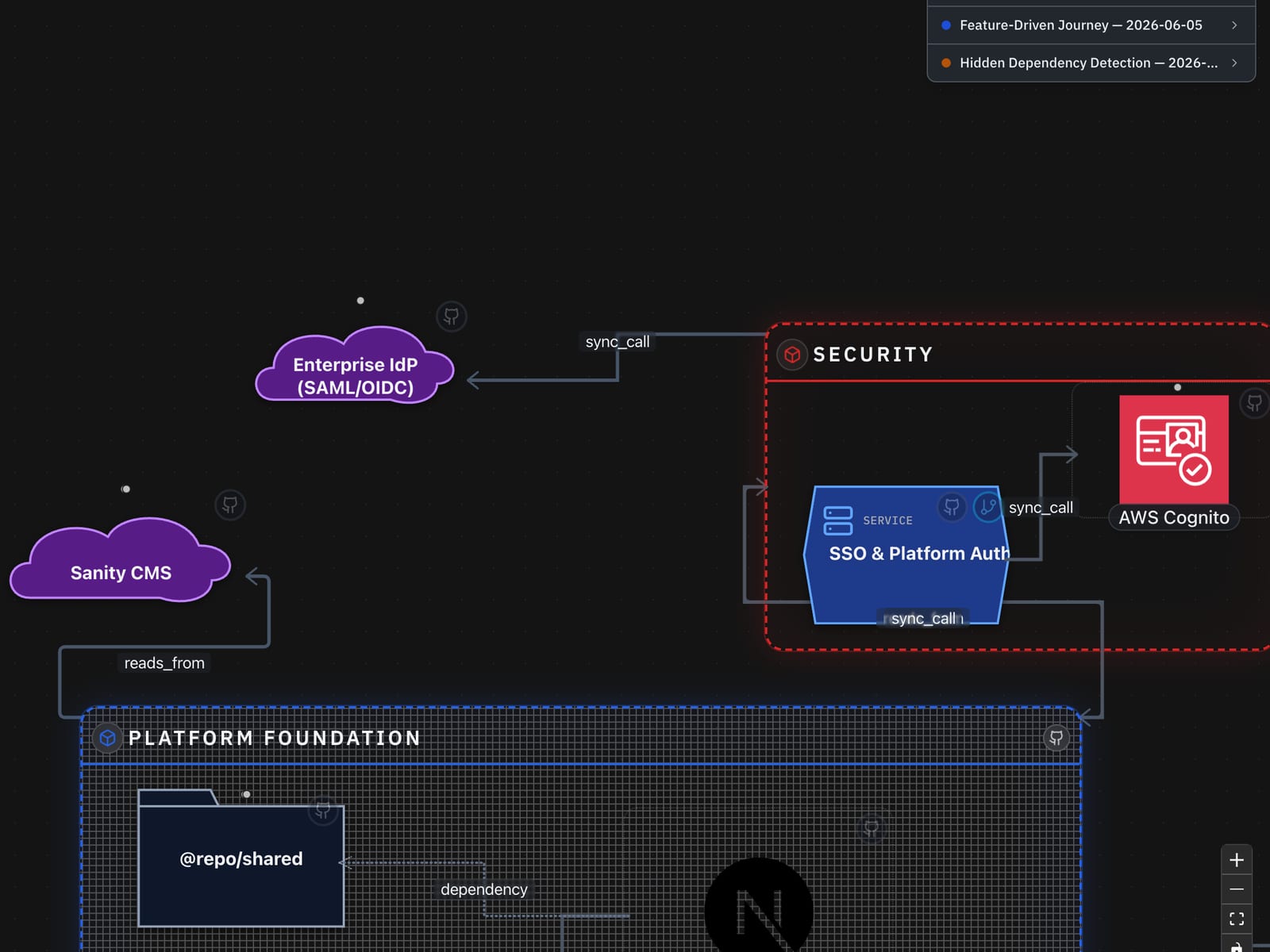
Not a mockup: the ProvenMap portal you're reading, as a live architecture board. Pan it and move through the structure.
Fig. 03The ProvenMap portal, published as a board and embedded live.
“We run on it. The board models our own portal, and we use the same map to review architecture, surface insights, plan work, and build the changes from it.”
The ProvenMap team
Building ProvenMap with ProvenMap
Drawn from this site’s own repository
Questions, answered.
Something else on your mind? Talk to us.
What is a board?
Does the map go stale?
Does my source code leave my machine?
Which coding agents does it work with?
Does it work from code alone?
Do I need a credit card to start?
Can we self-host ProvenMap?
Is single sign-on available?
Start with one system
Map a real system and see the architecture around it.
Start on the free plan, or book a walkthrough using your own system landscape.
No credit card · Analysis runs locally · Self-hosted available
Or for writing on architecture that stays connected across systems.