LangGraph + our abstraction: building ProvenMap's architectural intelligence agents
On this page
A note on this post. It was first published in August 2025, and the product has shipped since. The engineering described here — the type-safe layer we built over LangGraph — is unchanged, but some of the product surfaces it mentions were experiments that did not make it into the shipped product. Names and framing have been brought up to date; the technical content is as written.
How we solved type safety, human-AI collaboration, and visual workflow authoring in an agentic system.
Background
When we (a two-member team—my wife and I) decided to switch from Scala to Node.js/TypeScript for our backend in the middle of the project, while simultaneously moving from India to the UK, it was a difficult period in our lives. It was madness.
After working with Scala and Akka Persistence, and having built a workflow engine with a team of bright minds, and working on different workflow engines, LangGraph felt like a breath of fresh air due to its simplicity. Why did we switch from Scala to Node.js? As a two-member bootstrapped team (with small angel investment), we wanted the same stack across our entire platform—we also didn't want overlap with my previous company.
TL;DR: No regrets about switching to Node.js—huge thanks to LangGraph.
The problem we solved
We needed to build a platform where both technical and non-technical stakeholders gain visual access to their architecture. Like any modern platform, we chose to rely heavily on AI agents collaborating on complex software analysis workflows. The main challenge was building agents on-the-fly as users interact with their workspaces. The core challenges:
- Dynamic composable nodes - We made nodes composable; composed nodes are persisted in the database
- Predictable I/O for nodes - To make them composable, we built an I/O layer that leverages LangGraph's state annotation internally. We created abstractions—let's call them CNode and CEdge for discussion
- Runtime type safety - Visually built workflows need compile-time guarantees
- Human-AI collaboration - Seamless handoffs between AI analysis and human review, with resume-from-interrupt using shared schemas
- Comprehensive I/O analysis - Created a comprehensive I/O analysis layer that returns error lists when CNodes and CEdges are used
- Dynamic composition by humans - Non-technical users building type-safe workflows leveraging I/O
- Verifiability for end users - Error handling and simple observability
Our key abstraction over LangGraph: explicit input/output resolution
"LangGraph as a framework, particularly state annotation, is a powerful feature that centralizes node state management. The persistence layer and human-in-the-loop were so elegantly designed, effectively solving many challenges."
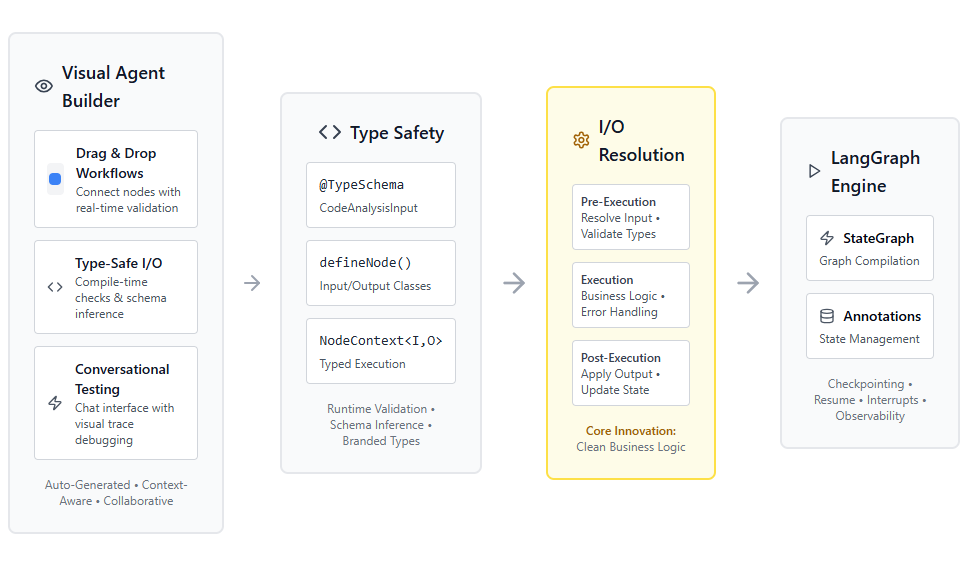
However, to build a composable and type-safe workflow in our case, we introduced explicit input and output concepts for each node that are resolved before node execution and applied upon node completion. All these properties are ultimately persisted to and resolved from the state annotation system via an abstracted node execution layer, which serves as the interface through which the LangGraph execution engine interacts with our concrete, composable nodes.
"This approach preserves LangGraph's strengths while enabling the type safety and composability we needed."
The core pattern
The magic: pre/post execution resolution
This gives us:
- Compile-time type checking for business logic
- Runtime validation through schema decorators
- Dynamic workflow composition without losing type safety
- Visual editor compatibility with full type information
"The real breakthrough was eliminating the impedance mismatch between typed business logic and LangGraph's dynamic state management while preserving the power of both approaches."
Real-world example: architecture review workflow
Key technical innovations
1. Branded types for domain safety
2. Schema strategy pattern across the platform
3. Human-in-the-loop forms
4. Effect-based error handling
Production features that matter
Resume from any point
Real-time collaboration
Comprehensive observability
What we learned
What worked well
- Input/Output resolution eliminates the impedance mismatch between typed business logic and LangGraph's dynamic state
- Schema decorators enable automatic UI generation and validation
- Branded types catch entire categories of bugs at compile time
- Human-in-the-loop interrupts feel natural when properly abstracted
"LangGraph's interrupt mechanism is elegantly designed—we just needed to bridge it with our type-safe form generation system."
Challenges we solved
- Dynamic schema validation - solved with runtime Zod schema generation
- Visual editor sync - solved with bidirectional state transformers
- Type safety in dynamic graphs - solved with schema strategy pattern
- Error recovery - solved with Effect library and comprehensive checkpointing
What we saw in our own testing
These are our own observations from building and exercising the system, not benchmarked claims:
- Runtime type errors in node execution effectively disappeared once I/O resolution was in place
- Workflow development got noticeably faster once schema-driven UI generation and the I/O analysis layer existed
- Human-AI handoffs felt immediate, with state pushed over WebSockets rather than polled
"The combination of LangGraph's checkpointing with our type-safe abstractions created a system that's both developer-friendly and production-reliable."
Key takeaways for the LangGraph community
I've worked with many workflow engines—JBPM, Activiti, Camunda, etc. After facing their limitations, even built workflow engine from scratch using Scala and Akka-persistence. I can say confidently that LangGraph (as stateful orchestration framework) surprised me with its simplicity and LLM-focused approach. It feels like process engines were reinvented for the AI era. What they've built is brilliant. LangGraph doesn't limit you, I feel. What we built is living proof of that flexibility.
The key lessons:
- Type safety is achievable in dynamic systems with the right resolution layer
- Human-AI collaboration requires careful interrupt design and state management
- Visual workflow builders can maintain type safety with proper schema management
The full system handles environment injection, nested graph execution, dynamic schema inference, and multi-tenant isolation.
Happy to dive deeper into any specific patterns that interest you.
Built with LangGraph.js, TypeScript, React Flow, and Effect.

Murali Krishna Ganta is the founder of ProvenMap, a software architecture intelligence platform. He previously built low-code platforms and worked on industrial digitalisation projects.
Syntaxia App Platform Ltd. Registered in England and Wales, company no. 15272701 Registered office: 3rd Floor, 86–90 Paul Street, London EC2A 4NE, United Kingdom contact@provenmap.com