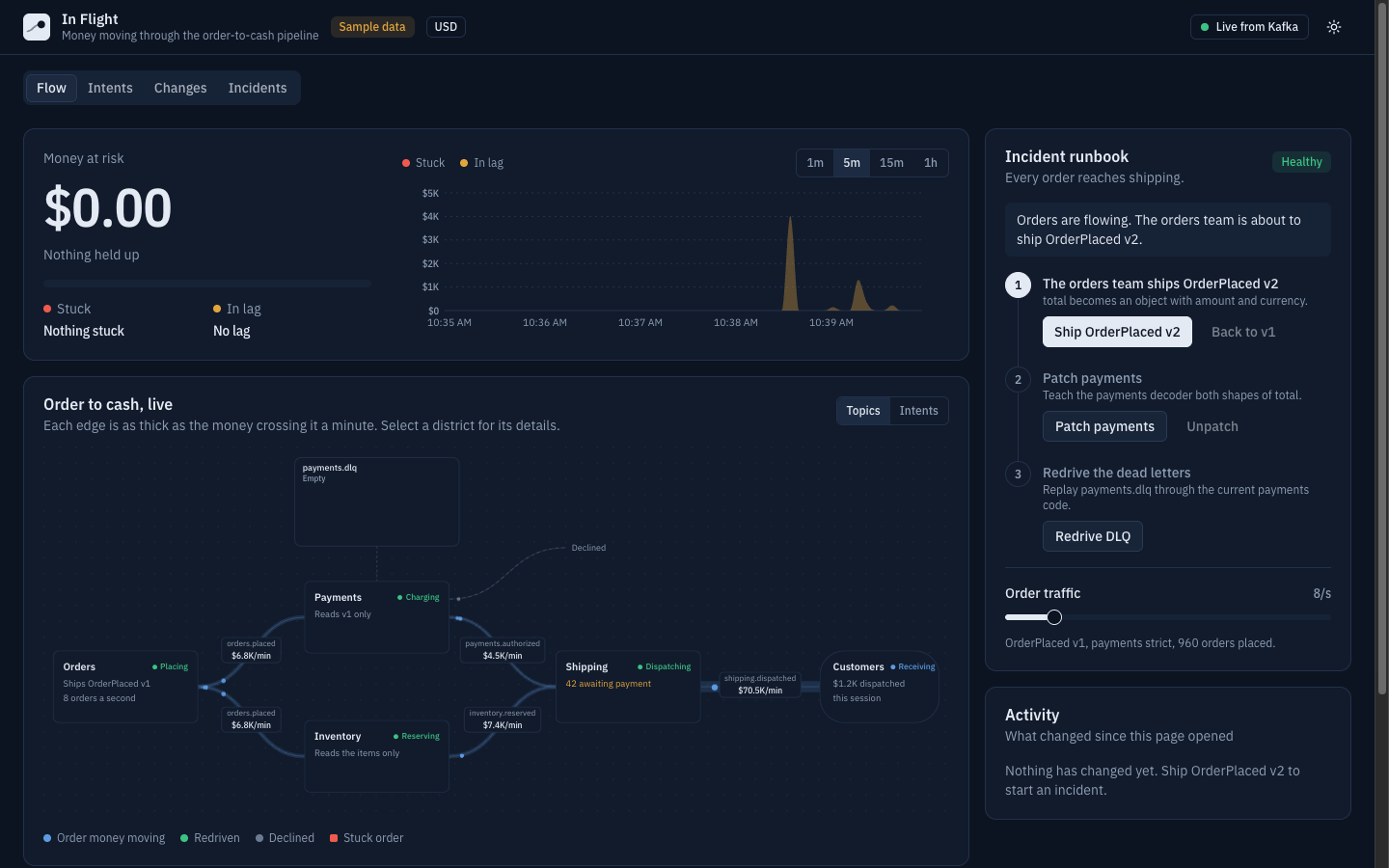
Build something like this?

App hub

In-flight: the money moving through your Kafka

In Flight: a console and an MCP server for the money (or any counted measure) moving through a Kafka cluster — it discovers a flow, values what is stuck and lets you redrive it. Container-grade L0 system context with 1 drill-down (the JVM server and engine) plus the inline React console, delivery tooling and the external systems it talks to.

1 layer5 insightsby Supportv1Published Nov 16, 2026

About this system

In Flight — system context

In Flight connects to a Kafka cluster, discovers one flow's topics, consumer groups and dead-letter queues, drafts a catalog of what each event is worth, and then shows what is stuck, for whom, and how much — and lets an operator redrive it.

Parts

  • In Flight server and engine (drill-down) — the Java/Maven modules: broker adapters (Kafka first), catalog and intent language, observer, router, contracts, discovery, recovery, simulator, the HTTP/WebSocket/MCP server, the CLI and the Kroxylicious proxy filters.
  • Console — the React + Vite single-page app the server serves: setup wizard, flow map, panels and a small UI kit.
  • Delivery — container image, local Kafka stack (docker-compose) and the GitHub release pipeline with the Homebrew formula.
  • Developer tooling — Playwright/ESLint configuration, the usage-video recorder and the add-broker Claude skill.

Talks to

Your Kafka cluster, a schema registry (Confluent or Apicurio), the Kroxylicious proxy, chat webhooks for alerts, a git repository for contract changes, secret sources (env/file/keychain), and GitHub for releases. Operators use the console; AI assistants use the MCP endpoint.

The map

The map · Spine

Architecture

What's on this map
  • Delivery · domain group
  • Container image · infrastructure component
  • Local Kafka stack · environment
  • CI and release pipeline · infrastructure component
  • Developer tooling · domain group
  • Browser test and lint config · cli tool
  • Usage video recorder · cli tool
  • Kafka cluster · kafka
  • Kroxylicious proxy · gateway
  • Git repository · github
  • GitHub · github
  • Operator · actor
  • AI assistant (MCP client) · actor
  • In Flight server and engine · backend app
  • Console · frontend app
  • add-broker skill · agent skill
  • Schema registry · schema model
  • Alert webhook · external integration
  • Secret sources · external integration

The map · Layers

Layers1

What's on each layer

In Flight server and engine

The JVM side of In Flight: the observe/connect/serve runtime and the catalog/intent/contracts/router core (both drill-downs), plus the intent-language support types, the Kafka entry point, the stream router runtime, the Kroxylicious proxy filters, console auth and the demo simulator. Terminal board: the plan fits its band, carrying 2 opaque drill-downs (broker, catalog).

  • Observe, Connect and Serve Runtime · module
  • Catalog, Intent Language and Router · module
  • Intent Language Support · module
  • Kafka Entry Point · adapter component
  • Intent Alias Proxy Filter · adapter component
  • Schema Gate Proxy Filter · adapter component
  • Stream Router Runtime · engine component
  • Console Auth · service component
  • Traffic Simulator · module
  • Rehearsal and Redrive · module

Observe, Connect and Serve Runtime

Broker module cluster: the broker-neutral SPI and Kafka adapter, decoding and pricing, observation and redrive, and the server, MCP and CLI surfaces. Grain: container-grade by band (one 50-file cluster the plan escalated), authored as module-level nodes with no child units; deeper splits are recorded as proposals.

  • Broker Access · domain group
  • Flow Understanding · domain group
  • Observation and Recovery · domain group
  • Console and Tooling · domain group
  • Broker SPI · class interface
  • Profile and Secrets · service component
  • Kafka Adapter · adapter component
  • Event Decoding · engine component
  • Catalog Pricing and JSON · engine component
  • Reader and Poller · engine component
  • Ledger · store component
  • Observer Facade · facade component
  • Redrive · service component
  • Engine and Server · service component
  • MCP Server · mcp server
  • Setup Actions and Causes · service component
  • Workspace and Alerts · repository component
  • CLI Setup and Rehearse · cli tool
  • Catalog, Intent Language and Router · boundary port
  • Intent Language Support · boundary port
  • Broker Model · schema model
  • Discovery · service component
  • Routed Event · schema model

Catalog, Intent Language and Router

Catalog, intent compilation and the router that runs intents as Kafka Streams applications. Grain: terminal, the plan fits the band with no drill-downs proposed beyond the contracts child unit.

  • Contracts · module
  • Router Service · service component
  • Catalog Model · service component
  • Intent Compiler · engine component
  • Describe · facade component
  • Registry · repository component
  • Intent Topology · engine component
  • Control API · controller component
  • CLI Main · cli tool
  • Observe, Connect and Serve Runtime · boundary port
  • Stream Router Runtime · boundary port
  • Traffic Simulator · boundary port

Contracts

How contracts ride the catalog: the semantic model and impact analysis, the commands and console that propose changes, and the router and codec that read events. Grain: terminal, the plan fits the band with one opaque child board for the contracts library.

  • Contracts · library package
  • Catalog Semantics and Impact · schema model
  • Contracts Command · cli tool
  • Impact Since · cli tool
  • Demo · cli tool
  • Protobuf Codec · adapter component
  • Route Processor · engine component
  • Console API · api endpoint
  • Changes Service · service component
  • Catalog Model · boundary port
  • Describe · boundary port
  • Intent Compiler · boundary port
  • Router Service · boundary port

Contracts

The contracts package: commands that analyse a proposed catalog revision, generate consumer bindings, register schemas in Apicurio and track the change until migrations merge. Grain: terminal, the plan proposes no drill-downs and the budget fits.

  • Change Tracking · domain group
  • Generation and Registry · domain group
  • Commands and I/O · domain group
  • Analysis · schema model
  • Change · schema model
  • Change Status · schema model
  • Change Store · repository component
  • Consumer Manifest · schema model
  • Binding Generator · engine component
  • JSON Schemas · engine component
  • Apicurio Client · adapter component
  • Contracts Exception · class interface
  • Git · adapter component
  • Http · adapter component
  • Catalog Semantics and Impact · boundary port
  • Contracts Commands · facade component

What to notice

Inbound · Signals

Insights3 analyses

5Insights
0Critical
strength3observation2
Read all 5

A console redrive reaches Kafka through one server-side write check

observation · high · verified

The Redrive button posts to /api/redrive (Redrive.tsx:63-64, Api.java:136-147). ConsoleAuth asks for a token only when bound beyond localhost (ConsoleAuth.java:27,51). Setup.redrive refuses a queue the catalog does not own, try mode, and a real run unless the running profile has allowWrites (Setup.java:324-334). Redrive then writes each match back through a Kafka producer, rate-limited (Redrive.java:115,201-214). The disabled button is cosmetic; Setup is the guard.

Impact: Whether a click becomes a production write depends on one flag on the saved profile, checked in exactly one place.

Guards in order: console token (only beyond localhost), confirm dialog and canWrite in the browser (Redrive.tsx:86-116, Engine.java:360), dlq must belong to the catalog, not try mode, profile allowWrites, perSecond default 50 capped at 5000 and optional limit (Redrive.java:67-73), error/order/time filters (Redrive.java:249-260). Dry run defaults on when dryRun is absent (Api.java:145).

  1. Operator
  2. Console
  3. In Flight server and engine
  4. Observe, Connect and Serve Runtime
  5. Console Auth
  6. Console API
  7. Setup Actions and Causes
  8. Redrive
  9. Broker SPI
  10. Kafka Adapter
  11. Kafka cluster

The MCP recovery tools score about 40 of 100 for unattended agent use

observation · medium · inferred

Scored on this code: schema 70 (closed argument objects, Mcp.java:149, but catalog and patch are open objects, Mcp.java:365, 375); escape hatch 60 (dry run by default, stop, console confirm); blast radius 30 (self-granted writes, any target topic, any secret path); observability 25; provenance 30; identity 20 (no per-agent scope). Cost is the client's: no model runs inside. The read-only tools score far higher: annotated read-only, masked samples (Mcp.java:329).

Safe first moves: observe-mode agents on value_at_risk, stuck_events and impact, and augment-mode drafting with draft_catalog. Not yet: a real redrive, edit_catalog on an active flow, approve_change. First architectural move: make write authority something the person grants per action, not a profile field the agent can set.

  1. MCP Server
  2. Observer Facade
  3. Redrive

Cluster writes are off by default and pass one shared gate

strength · medium · verified

Console, MCP and CLI redrive through Setup.redrive (Setup.java:29-33), refusing unless the queue belongs to the active flow (324-327), the engine is not sample data (328), and the running profile allows writes (331-334); that flag defaults to false (Workspace.java:171; Mcp.java:301). All three default to a dry run (Mcp.java:528, Api.java:145, Setups.java:249). A pass is rate-capped (Redrive.java:69), stops at the queue's end as of its start (105, 153), and skips letters already redriven (158).

Impact: A mistaken run is confined to one queue of the active flow, one pass and the rate cap, and nothing is written unless a profile was explicitly opened for writes.

The gate bounds where and how fast a run writes, not how many records match or who else reads the target topic; those are the open edges of the blast radius covered by the other findings. The redrive tool is only offered when the server runs from the workspace (Mcp.java:497), and writers exist only on adapters declaring the redrive capability (Redrive.java:97).

  1. Setup Actions and Causes
  2. Redrive
  3. Broker SPI
  4. Kafka Adapter

An MCP redrive passes a strict HTTP guard, then the same Setup check

strength · medium · verified

Over HTTP, McpHttp refuses any Host that is not localhost and any foreign Origin when bound locally, and stays off beyond localhost until INFLIGHT_MCP_TOKEN is set, compared in constant time (McpHttp.java:73-104). The redrive tool exists only in app mode, is marked destructive, defaults to a dry run, and calls the same Setup.redrive as the console (Mcp.java:498-528, 167-168). Over stdio there is no transport guard: the client process is trusted.

Impact: A web page cannot reach /mcp through DNS rebinding, and a client that honours the destructive hint asks before a real run.

The CLI path converges too: in-flight redrive is a dry run unless --run is given and calls the same Setup.redrive (Setups.java:249).

  1. AI assistant (MCP client)
  2. In Flight server and engine
  3. Observe, Connect and Serve Runtime
  4. MCP Server
  5. Setup Actions and Causes
  6. Redrive

Every redrive goes through one method with a dry run and a rate cap

strength · low · verified

Console, MCP and CLI all call Setup.redrive, which refuses queues the catalog does not list (Setup.java:324), allows one run per queue within one process (Setup.java:346) and defaults to a dry run (Mcp.java:528, Api.java:145; the CLI needs --run). Redrive caps the rate at 5000 a second, default 50 (Redrive.java:69), stops at the end offsets seen at start, and marks replays with a redriveof header (Redrive.java:212).

Impact: A single place to add a human approval or a per-agent write capability, inherited by every surface at once.

The console adds a confirm step naming the bootstrap servers (ui/src/panels/Redrive.tsx) and the MCP tool is annotated destructive (Mcp.java:167-169), so clients that honour annotations prompt too. The missing piece is a server-side check that the person, not the caller, chose to write. Replays are not deduplicated: a failed send or a parallel CLI run can write up to 99 records again (Redrive.java:215-227).

  1. Redrive
  2. MCP Server
  3. Setup Actions and Causes
  4. CLI Setup and Rehearse

In the code

Endpoints 43 · Pages 1 · Events 10 · Clients 7

Inbound · From code

Endpoints

43endpoints

Public
7
Deprecated
0
Rate-limited
0
By method
  • GET21
  • POST14
  • PUT4
  • DELETE2
  • PATCH1
  • WEBSOCKET1

Endpoints

+39 more

Inbound · From code

Pages

1page

Guarded
0
With forms
1
Unguarded writes
0
Captures
/

Pages

Inbound · From code

Events

10channels

6 without a dead-letter queue

Event types
6
Subscriptions
9
No dead-letter
6

Needs a look

+2 more

Event types per channel
  • intent.order-total-changes1
  • inventory.reserved1
  • orders.placed1
  • payments.authorized1
  • payments.declined1

+5 more

Inbound · From code

Clients

7clients

HTTP
7
gRPC
0
Calls
26
Calls by target
  • schema-registry11
  • server9
  • simulator5
  • chat-webhook1

Clients

+3 more